GraphQL Vulnerabilities Prevention Checklist for Secure APIs
GraphQL shifts injection risks from the network layer to the application logic, requiring depth limits and query complexity analysis to prevent denial-of-service attacks that bypass traditional firewalls.

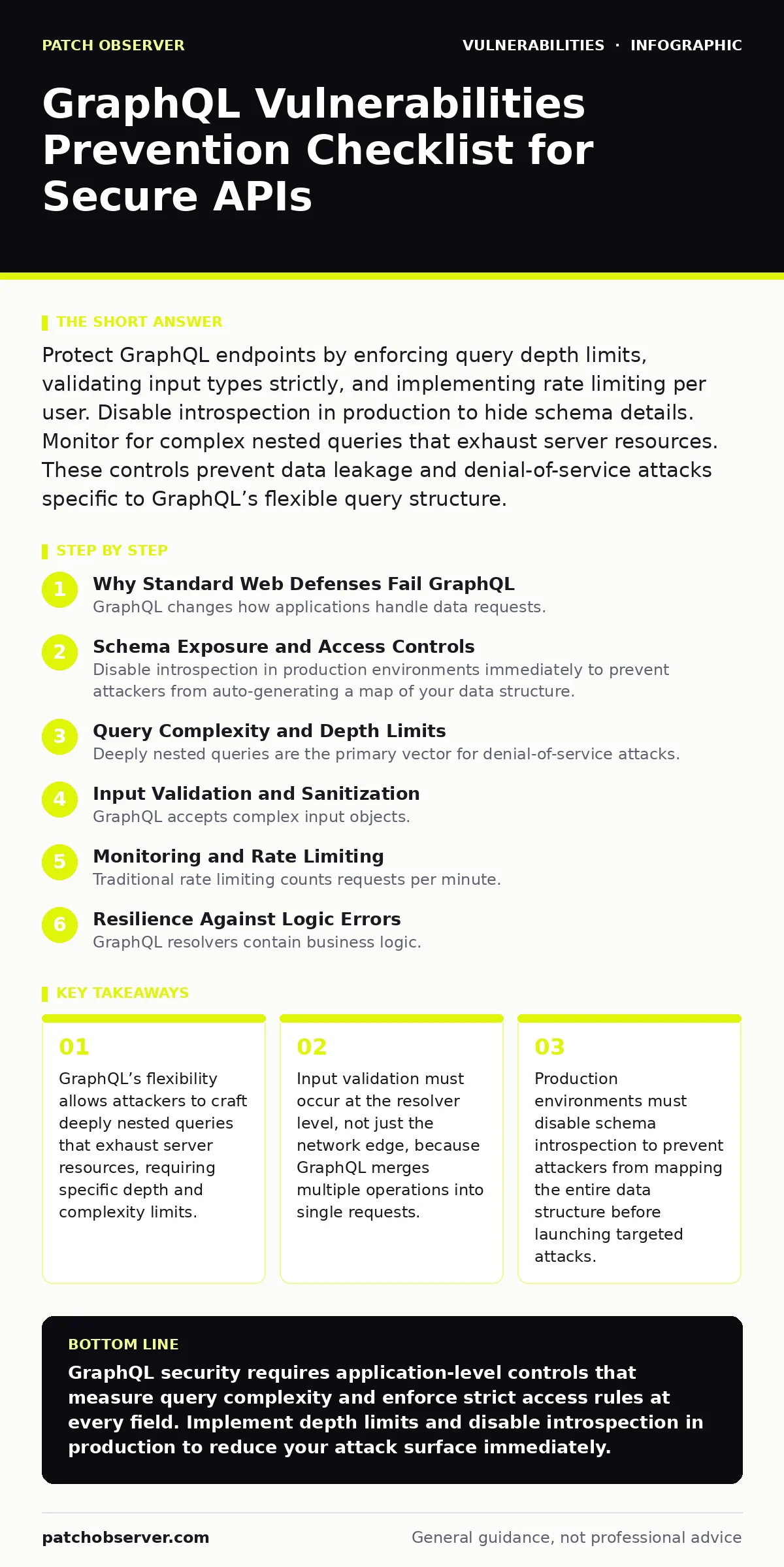
Protect GraphQL endpoints by enforcing query depth limits, validating input types strictly, and implementing rate limiting per user. Disable introspection in production to hide schema details. Monitor for complex nested queries that exhaust server resources. These controls prevent data leakage and denial-of-service attacks specific to GraphQL’s flexible query structure.
Why Standard Web Defenses Fail GraphQL
GraphQL changes how applications handle data requests. Traditional REST APIs expose fixed endpoints. Attackers probe these endpoints to find hidden routes. GraphQL uses a single endpoint for all data operations. This design hides the surface area but concentrates risk. Network-level firewalls see only one connection. They cannot distinguish between a simple user profile request and a complex attack. You must move security controls into the application logic. The application must understand the structure of every query before processing it. This shift requires new monitoring and validation techniques.
Imagine an attacker sends a query that requests user data for every record in your database. A traditional firewall sees one HTTP POST request. It allows the traffic through. The backend database receives thousands of individual lookups. The server crashes under the load. This is a denial-of-service attack specific to GraphQL. Standard rate limiting based on request count fails here. One request can contain massive computational weight. You need controls that measure query complexity, not just frequency.
Schema Exposure and Access Controls
GraphQL servers often enable introspection by default. This feature allows clients to query the schema itself. It reveals field names, types, and relationships. In development, this is helpful. In production, it is a roadmap for attackers. They use this information to construct precise queries. They target sensitive fields like email addresses or internal IDs. You must disable introspection when deploying to public networks.
Access control in GraphQL differs from REST. REST endpoints often have coarse-grained permissions. A user might access /api/users but not /api/admin. GraphQL fields are fine-grained. A single query can request public and private fields together. The server must check permissions for every field in every query. If one field lacks authorization, the entire request should fail or filter the data. Implementing this check at the resolver level ensures consistency. Resolvers are the functions that fetch data for specific fields. They are the last line of defense.
Query Complexity and Depth Limits
Deeply nested queries are the primary vector for denial-of-service attacks. An attacker can request a user, their friends, their friends' friends, and so on. Each level multiplies the number of database calls. This is known as the N+1 problem. Without limits, a single query can trigger millions of operations. You must enforce depth limits. This restricts how many levels of nesting a query can have. A limit of 5 or 10 levels usually suffices for legitimate use cases.
Depth limits alone are not enough. An attacker can create a wide query. They request many fields at a single depth level. You need query complexity analysis. This assigns a cost to each field. Simple fields cost 1. Fields requiring database joins cost more. The server sums these costs. If the total exceeds a threshold, the server rejects the request. This prevents resource exhaustion. It balances performance and security. You must tune these thresholds based on your server capacity.
Input Validation and Sanitization
GraphQL accepts complex input objects. Attackers can inject malicious data into these objects. They might try to bypass type checks. They might inject code into string fields. You must validate all inputs strictly. Define exact types for every argument. Reject any input that does not match the schema. Do not trust client-side validation. Clients can bypass these checks easily. Server-side validation is mandatory.
Sanitize data before storing it. Remove or escape special characters that could trigger injection attacks. Even if GraphQL handles the structure, your resolvers interact with databases. SQL injection risks remain if you concatenate strings in queries. Use parameterized queries in your resolvers. This ensures data is treated as data, not executable code. This practice aligns with secure configuration baselines for database interactions.
Monitoring and Rate Limiting
Traditional rate limiting counts requests per minute. This approach fails for GraphQL. One request can contain heavy logic. You must implement per-user rate limiting based on query cost. Track the complexity score of each query. Accumulate these scores over time. If a user exceeds the budget, block further requests. This protects shared resources. It prevents a single user from starving others.
Monitor for unusual query patterns. Look for queries that request rarely used fields. Look for queries that combine unrelated data types. These patterns often indicate reconnaissance. Set up alerts for high-complexity queries. Review logs regularly. Ensure your logging library vulnerabilities are patched. Secure logs help you detect and respond to attacks. They provide evidence for forensic analysis. Do not log sensitive data. Mask personal information in logs to maintain privacy.
Resilience Against Logic Errors
GraphQL resolvers contain business logic. Bugs in this logic can lead to vulnerabilities. Integer overflow vulnerabilities can occur if you perform calculations on large numbers. Validate input ranges before processing. Ensure your code handles edge cases gracefully. Test resolvers with unexpected inputs. Fuzz testing helps find these issues. It sends random data to your API. It reveals how your application handles malformed requests. This proactive testing strengthens your defense.
Review your code for race conditions. Concurrent queries might access shared state. Ensure your application handles concurrency safely. Use transactions where appropriate. This prevents data corruption. It ensures consistency. Regular code reviews help catch these issues. Pair programming can also improve code quality. Share knowledge within your team. Discuss potential attack vectors. This collaborative approach builds a stronger security culture.
Key takeaways
- GraphQL’s flexibility allows attackers to craft deeply nested queries that exhaust server resources, requiring specific depth and complexity limits.
- Input validation must occur at the resolver level, not just the network edge, because GraphQL merges multiple operations into single requests.
- Production environments must disable schema introspection to prevent attackers from mapping the entire data structure before launching targeted attacks.
GraphQL security requires application-level controls that measure query complexity and enforce strict access rules at every field. Implement depth limits and disable introspection in production to reduce your attack surface immediately.
Frequently asked questions
Does GraphQL eliminate SQL injection risks?
No, GraphQL does not eliminate SQL injection. Resolvers still interact with databases. If you concatenate user input into SQL strings, you remain vulnerable. Use parameterized queries in your resolvers to prevent this.
Can I use a WAF to protect GraphQL?
Web Application Firewalls can help with basic filtering. They cannot fully protect GraphQL. WAFs struggle to understand query complexity and depth. You need application-level controls to manage these specific risks effectively.
How do I handle authentication in GraphQL?
Use standard authentication methods like JWT tokens. Include the token in the HTTP header. Validate the token at the gateway level. Check permissions at the resolver level for each field. This ensures fine-grained access control.
Is GraphQL slower than REST?
GraphQL can be more efficient for clients. It reduces over-fetching. However, complex queries can strain servers. Proper optimization and caching are required. Monitor performance metrics to ensure scalability.
How this guide was produced: written by the Patch Observer editorial team with AI assistance, checked against the public references listed below, and reviewed when the facts change. See our editorial policy or report an error.