Payment Verification Procedures: Implementation Steps and Validation
Standard authentication often fails to verify transaction intent, allowing attackers to bypass controls even when credentials are correct.

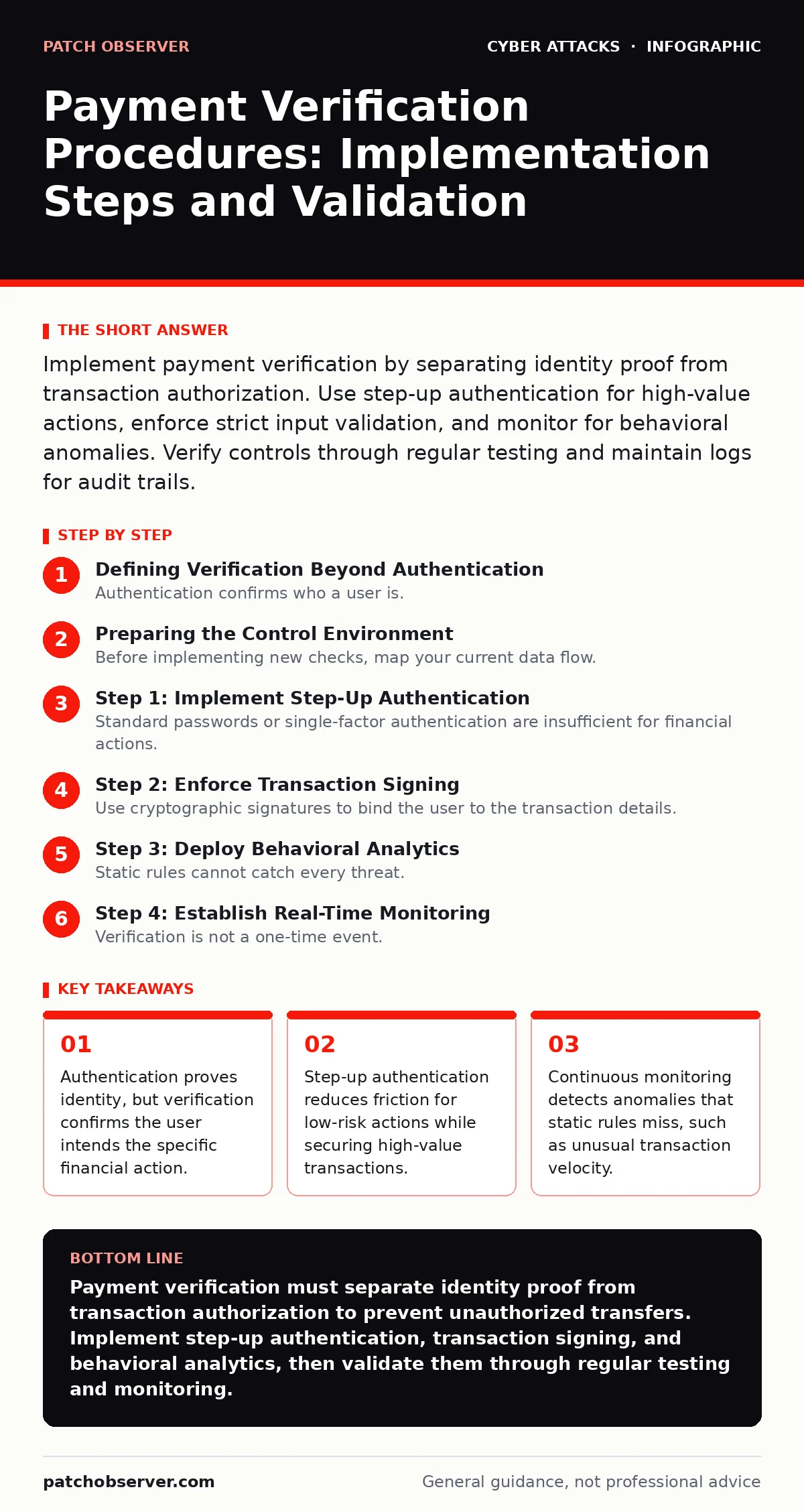
Implement payment verification by separating identity proof from transaction authorization. Use step-up authentication for high-value actions, enforce strict input validation, and monitor for behavioral anomalies. Verify controls through regular testing and maintain logs for audit trails.
Defining Verification Beyond Authentication
Authentication confirms who a user is. Verification confirms that the user intends to perform a specific action. Many systems treat these as identical, leading to gaps where an attacker with stolen credentials can authorize transfers. You must separate these functions in your architecture. Identity management handles login. Transaction verification handles the payment event. This separation ensures that compromising one layer does not automatically compromise the other. It forces an attacker to bypass two distinct controls rather than one.
Preparing the Control Environment
Before implementing new checks, map your current data flow. Identify where payment requests originate and where they are processed. You need clear visibility into these paths to insert verification steps. Define what constitutes a high-risk transaction in your context. This might include large amounts, new beneficiaries, or unusual geographic locations. Establish baseline behavior for typical users. This baseline allows your system to flag deviations. Without a baseline, anomaly detection lacks context and generates excessive false positives.
Step 1: Implement Step-Up Authentication
Standard passwords or single-factor authentication are insufficient for financial actions. Implement step-up authentication for sensitive transactions. This requires additional proof of identity when risk indicators are present. For example, a user logging in from a known device may not need extra checks. The same user initiating a wire transfer should receive a one-time code or biometric prompt. This balances security with user experience. It avoids friction for routine actions while securing critical ones.
Verification of Step-Up Controls
Test the trigger conditions. Initiate a transaction that meets the high-risk criteria. Confirm that the system requests additional authentication. Then, initiate a low-risk action. Ensure the system does not request extra steps. This confirms the logic differentiates correctly. Check that the additional factor is bound to the specific transaction. This prevents replay attacks where an attacker reuses a valid code for a different amount.
Step 2: Enforce Transaction Signing
Use cryptographic signatures to bind the user to the transaction details. The user must approve the exact amount, recipient, and currency. This prevents manipulation of parameters during transmission. The signature ensures that any change invalidates the request. You must generate the signature on the client side using a secure method. The server then verifies the signature before processing. This mechanism protects against man-in-the-middle attacks that alter payment data in transit.
Verification of Transaction Signing
Attempt to modify transaction parameters after signing. Change the recipient account number or the amount. Submit the request. The system must reject it due to a signature mismatch. This confirms the integrity of the data. Ensure the signature includes a timestamp. This prevents delayed submission of old, valid signatures.
Step 3: Deploy Behavioral Analytics
Static rules cannot catch every threat. Implement behavioral analytics to monitor user patterns. Track login times, device usage, and transaction frequency. Machine learning models can identify deviations from established baselines. For instance, a sudden spike in transaction volume may indicate account takeover. The system should flag these events for review. It can also automatically block high-confidence threats. This adds a dynamic layer of defense that adapts to new tactics.
Verification of Behavioral Analytics
Simulate anomalous behavior. Perform transactions at unusual hours or from new devices. Check if the system flags the activity. Review the alerts for accuracy. Ensure the system does not flag normal variations, such as a user traveling. Fine-tune the sensitivity to reduce noise. This step requires ongoing adjustment as user behavior evolves.
Step 4: Establish Real-Time Monitoring
Verification is not a one-time event. Implement real-time monitoring of all payment attempts. Log every step of the process, including authentication and signing. Correlate logs from different systems to see the full picture. This helps detect coordinated attacks that span multiple services. Set up alerts for suspicious patterns, such as multiple failed attempts followed by a success. Investigate these alerts promptly. Delay reduces the effectiveness of containment measures.
Verification of Monitoring
Generate a series of failed and successful transactions. Verify that all events appear in the logs. Check that the correlation engine links related events. Ensure alerts trigger for the defined suspicious patterns. Confirm that the investigation team receives the alerts in time. This confirms the end-to-end visibility of the process.
Maintenance and Continuous Improvement
Security controls degrade over time. Attackers adapt to bypass static rules. You must regularly review and update your verification procedures. Analyze false positives and negatives to refine your models. Update threat intelligence feeds to include new attack vectors. Conduct periodic penetration tests to validate your defenses. These tests simulate real-world attacks to find gaps. Use the findings to improve your controls. This cycle of testing and improvement keeps your system resilient.
Verification Checklist
Use this checklist to validate your implementation.
- Step-up authentication triggers correctly for high-risk actions.
- Transaction signing binds all critical parameters.
- Behavioral analytics flag anomalous patterns without excessive noise.
- Real-time monitoring logs all payment events.
- Alerts correlate related events across systems.
- Penetration tests validate the effectiveness of controls.
- False positives are reviewed and models updated.
Handling Edge Cases and Exceptions
Not all transactions fit standard patterns. You must define procedures for exceptions. For example, high-value corporate transfers may require multi-party approval. Implement workflows that support these scenarios. Ensure that the verification steps are appropriate for the risk level. Do not bypass security for convenience. Document all exceptions and review them regularly. This prevents abuse of exception processes.
Integrating with Broader Security
Payment verification does not exist in isolation. It must work with other security layers. For example, secure email gateways can prevent phishing attempts that lead to account takeover. By stopping the initial compromise, you reduce the load on payment verification. Similarly, monitoring for smishing attempts helps identify users who may have shared credentials. Cross-referencing these data sources improves detection accuracy. A holistic approach strengthens your overall defense.
Key takeaways
- Authentication proves identity, but verification confirms the user intends the specific financial action.
- Step-up authentication reduces friction for low-risk actions while securing high-value transactions.
- Continuous monitoring detects anomalies that static rules miss, such as unusual transaction velocity.
Payment verification must separate identity proof from transaction authorization to prevent unauthorized transfers. Implement step-up authentication, transaction signing, and behavioral analytics, then validate them through regular testing and monitoring.
Frequently asked questions
How do I balance security with user experience?
Use step-up authentication to apply stricter checks only to high-risk actions. This minimizes friction for routine transactions while securing sensitive ones.
What if a user loses access to their second factor?
Implement a secure recovery process that requires multiple proofs of identity. This process should be manual and reviewed by a security team to prevent abuse.
How often should I update my behavioral models?
Update models regularly based on new data and threat intelligence. Continuous learning ensures the system adapts to changing user behavior and attack tactics.
Can I rely on third-party verification services?
Third-party services can enhance security, but you remain responsible for the outcome. Ensure their controls align
How this guide was produced: written by the Patch Observer editorial team with AI assistance, checked against the public references listed below, and reviewed when the facts change. See our editorial policy or report an error.