Spotting Null Pointer Dereference Bugs Before They Crash Systems
Null pointer dereferences often hide behind silent data corruption rather than loud crashes, making static analysis insufficient for full detection.

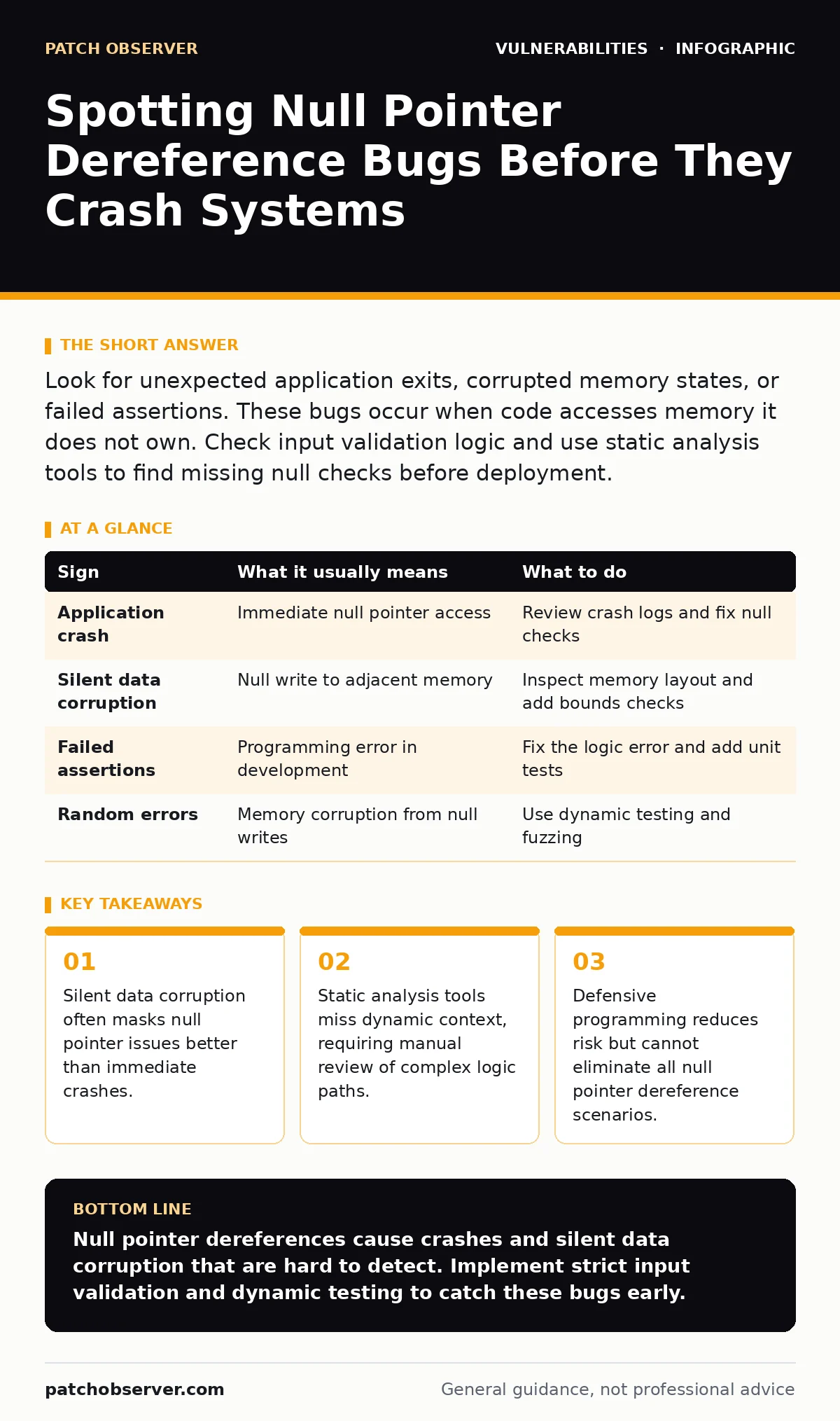
Look for unexpected application exits, corrupted memory states, or failed assertions. These bugs occur when code accesses memory it does not own. Check input validation logic and use static analysis tools to find missing null checks before deployment.
First Signs of Null Pointer Dereference
Application crashes are the most obvious indicator of a null pointer dereference. A null pointer dereference happens when software tries to read or write to a memory address that holds a null value. This usually triggers an immediate termination of the process. You see core dumps on Linux systems or blue screens on Windows machines. The error logs will point to a specific function that attempted to use an invalid reference.
These crashes often happen during specific user actions. Imagine a user submitting a form with empty fields. The backend code assumes the field contains data. It tries to process that empty value. The pointer is null. The system crashes. This direct cause-and-effect relationship makes these bugs relatively easy to reproduce once you know the trigger.
Silent Failures and Hidden Corruption
Not all null pointer dereferences result in immediate crashes. Some systems handle the error gracefully by returning an error code. Other systems continue running with corrupted data. This silent failure is dangerous because it delays detection. You might not notice the problem until days later. Data integrity issues surface in reports or downstream applications.
Memory corruption is a subtle sign. If a null pointer write occurs, it might overwrite adjacent memory. This can change variables in unrelated parts of the program. The application behaves erratically. It might delete the wrong record or display incorrect user profiles. These symptoms seem random. They are actually the result of memory layout changes. Debugging these issues requires deep memory inspection.
Static Analysis Limitations
Static analysis tools scan code without running it. They find many null pointer risks. They miss others. These tools cannot predict the runtime state of variables. They struggle with complex logic paths. A tool might flag a potential null check. It might miss a case where a function returns null under rare conditions. You cannot rely solely on automated scans.
False negatives are common in static analysis. The tool assumes a function always returns a valid object. It does not know the function can fail. This gap leaves vulnerabilities in production code. You must combine static analysis with dynamic testing. Dynamic testing runs the code with real inputs. It catches runtime errors that static tools miss. This dual approach provides better coverage.
Dynamic Testing Strategies
Dynamic testing involves running the application with various inputs. Fuzzing is a powerful technique. Fuzzing sends random or malformed data to the application. It stresses the code paths. It triggers unexpected null returns. You watch for crashes or abnormal behavior. This method finds bugs that manual testing misses.
Unit tests are also critical. Write tests that pass null values to functions. Ensure the functions handle them correctly. Check for proper error handling. Verify that the application does not crash. These tests validate your defensive coding. They prove that your null checks work. Regular regression testing keeps these protections active.
Defensive Coding Practices
Defensive programming reduces null pointer risks. Always check pointers before using them. Add null checks at every entry point. Validate inputs from external sources. Assume data can be missing or malformed. This mindset prevents many errors. It adds small overhead to your code. The cost is minimal compared to the risk of crashes.
Use assertions in development builds. Assertions catch programming errors early. They stop execution when a pointer is null. This helps developers fix bugs before release. Disable assertions in production if performance is critical. Use logging instead. Log null pointer events. This provides visibility into runtime behavior.
Table of Common Signs and Actions
| Sign | What it usually means | What to do |
|---|---|---|
| Application crash | Immediate null pointer access | Review crash logs and fix null checks |
| Silent data corruption | Null write to adjacent memory | Inspect memory layout and add bounds checks |
| Failed assertions | Programming error in development | Fix the logic error and add unit tests |
| Random errors | Memory corruption from null writes | Use dynamic testing and fuzzing |
Related Vulnerability Context
Null pointer dereferences often interact with other vulnerabilities. For instance, integer overflow vulnerabilities can lead to invalid memory addresses. If an integer overflows, it might point to a null region. This creates a null pointer dereference. Understanding this link helps you prioritize fixes.
See our guide on integer overflow vulnerabilities for more details on how arithmetic errors cause memory issues. Also, review server-side template injection risks. Template engines might receive null objects. They might try to render them. This can cause null pointer errors. Proper input validation prevents this.
Mitigation and Monitoring
Implement monitoring for application stability. Track crash rates and error logs. Set up alerts for sudden spikes in errors. This helps you detect new null pointer issues quickly. Investigate each alert. Determine if it is a new bug or a known issue. Fix new bugs promptly.
Use code reviews to catch null pointer risks. Have peers review your code. They might spot missing checks. They might suggest better patterns. Code reviews improve code quality. They reduce the likelihood of deployment issues. Combine reviews with automated testing for best results.
Key takeaways
- Silent data corruption often masks null pointer issues better than immediate crashes.
- Static analysis tools miss dynamic context, requiring manual review of complex logic paths.
- Defensive programming reduces risk but cannot eliminate all null pointer dereference scenarios.
Null pointer dereferences cause crashes and silent data corruption that are hard to detect. Implement strict input validation and dynamic testing to catch these bugs early.
Frequently asked questions
How do I find null pointer dereferences in legacy code?
Use static analysis tools to scan the codebase. Combine this with dynamic testing and fuzzing to trigger runtime errors. Review crash logs for patterns.
Can null pointer dereferences be exploited for remote code execution?
In some cases, yes. If the null write corrupts function pointers, an attacker might redirect execution. This is rare but possible in specific memory layouts.
What is the best way to prevent null pointer dereferences?
Always validate inputs and check pointers before use. Use static analysis and dynamic testing. Implement defensive programming practices in your codebase.
Do modern programming languages prevent null pointer dereferences?
Some languages, like Rust, prevent null pointers by design. Others, like Java and C++, require manual checks. The language choice affects your risk level.
How this guide was produced: written by the Patch Observer editorial team with AI assistance, checked against the public references listed below, and reviewed when the facts change. See our editorial policy or report an error.