Detecting SAML Authentication Bypass in Enterprise Logs
SAML bypass attacks often leave no failed login attempts, creating silent gaps in access records that standard monitoring misses entirely.

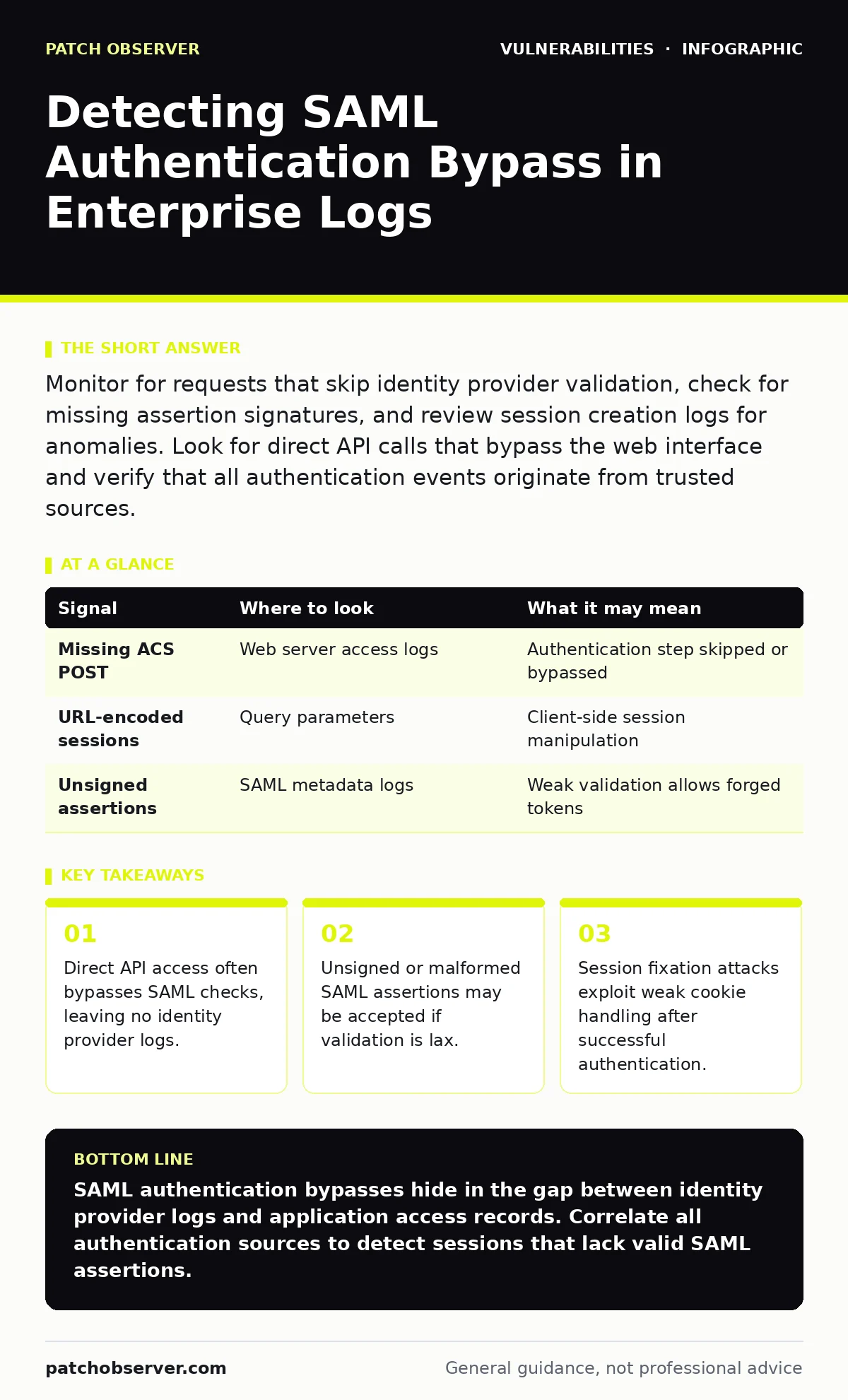
Monitor for requests that skip identity provider validation, check for missing assertion signatures, and review session creation logs for anomalies. Look for direct API calls that bypass the web interface and verify that all authentication events originate from trusted sources.
Understanding the SAML Bypass Mechanism
SAML authentication bypass occurs when an attacker accesses resources without completing the identity provider verification process. This exploit targets the service provider logic rather than the identity provider itself. The attacker manipulates request parameters or exploits misconfigurations to force the application to accept a forged or missing authentication token. This method allows unauthorized access while appearing as legitimate traffic.
The core vulnerability lies in trusting client-side data over server-side validation. Applications that accept session tokens directly from URLs or headers without verifying their origin create an attack surface. Attackers exploit this trust to inject their own credentials or skip authentication steps. Understanding this flow helps you identify where the breakdown occurs.
Analyzing Web Server Access Logs
Web server logs provide the first line of evidence for SAML authentication bypass attempts. Look for requests to protected resources that lack corresponding authentication subrequests. Standard SAML flows generate specific HTTP POST requests to the Assertion Consumer Service endpoint. Absence of these requests for successful logins indicates a potential bypass.
Check for unusual query parameters in URL strings. Attackers often append session identifiers or authentication flags to bypass checks. These parameters may mimic valid tokens but originate from external sources. Monitor for high-frequency requests to these endpoints from single IP addresses. This behavior suggests automated probing for bypass conditions.
| Signal | Where to look | What it may mean |
|---|---|---|
| Missing ACS POST | Web server access logs | Authentication step skipped or bypassed |
| URL-encoded sessions | Query parameters | Client-side session manipulation |
| Unsigned assertions | SAML metadata logs | Weak validation allows forged tokens |
Inspecting Identity Provider Audit Trails
The identity provider maintains records of all authentication events. Compare these logs with service provider access records. Discrepancies between successful logins at the provider and access at the consumer reveal bypass activity. If a user accesses an application without a corresponding SAML assertion issuance, the authentication chain is broken.
Review the timestamp alignment between provider and consumer logs. Slight delays may indicate replay attacks where old assertions are reused. Large gaps suggest direct access without provider involvement. Ensure that all successful sessions have a unique identifier that traces back to a specific authentication event. This correlation prevents session hijacking.
Evaluating Application-Level Session Handling
Application logs reveal how sessions are created and maintained. SAML authentication bypass often exploits weak session management. Attackers may inject session IDs into cookies or headers to assume existing identities. Check for session creations that do not reference a valid SAML assertion. These orphaned sessions indicate a failure in the authentication handshake.
Monitor for session fixation attempts. Attackers set a session cookie before authentication and reuse it after login. If the application does not regenerate the session ID post-authentication, the attacker retains access. Verify that session tokens are bound to the user identity and cannot be reused across different authentication contexts. This binding prevents identity theft.
Detecting Direct API Abuse
Many modern applications expose APIs that bypass the web interface. These endpoints often require different authentication mechanisms, such as API keys or JWT tokens. Attackers exploit these paths to avoid SAML checks entirely. Review API gateway logs for requests that access protected resources without SAML validation.
Ensure that all API endpoints enforce the same authentication standards as the web interface. Inconsistent security controls create easy entry points. Check for API calls that originate from unexpected IP ranges or user agents. These anomalies may indicate automated scripts testing for bypass conditions. Restrict API access to known clients and monitor for unusual usage patterns.
Identifying Configuration Weaknesses
Misconfigurations are the primary cause of SAML authentication bypass vulnerabilities. Common errors include accepting unsigned assertions, disabling certificate validation, or allowing redirect attacks. Review your SAML configuration for strict validation rules. Ensure that all assertions are signed by trusted identity providers and that signatures are verified.
Check for open redirect vulnerabilities in the SAML flow. Attackers use these to redirect users to malicious sites after authentication. Verify that the RelayState parameter is validated and does not contain executable code. Regularly audit your SAML metadata to ensure that only authorized identity providers are listed. This prevents unauthorized entities from issuing valid assertions.
Common Blind Spots in Monitoring
Security teams often miss SAML authentication bypass attempts due to blind spots in monitoring. One major gap is the lack of correlation between web and API logs. Treating these channels separately hides the full attack picture. Integrate log sources to create a unified view of user activity. This integration reveals discrepancies that indicate bypass attempts.
Another blind spot is the assumption that successful logins are always legitimate. Attackers use valid credentials or forged tokens to appear normal. Focus on the method of authentication rather than just the outcome. Monitor for unusual sequences of events, such as immediate access to sensitive data after login. These patterns suggest automated exploitation rather than human behavior.
Tools for Continuous Detection
Several tools assist in detecting SAML authentication bypass attempts. Security Information and Event Management platforms aggregate logs from multiple sources. Configure these platforms to alert on discrepancies between identity provider and service provider logs. Use custom queries to identify sessions without corresponding authentication events. This proactive monitoring catches bypass attempts early.
Application Performance Monitoring tools track request flows and performance metrics. Anomalies in request patterns may indicate bypass attempts. Integrate these tools with your security operations center for real-time alerts. Regularly test your SAML configuration with penetration testing tools. This validation ensures that your defenses remain effective against evolving threats.
Key takeaways
- Direct API access often bypasses SAML checks, leaving no identity provider logs.
- Unsigned or malformed SAML assertions may be accepted if validation is lax.
- Session fixation attacks exploit weak cookie handling after successful authentication.
SAML authentication bypasses hide in the gap between identity provider logs and application access records. Correlate all authentication sources to detect sessions that lack valid SAML assertions.
Frequently asked questions
How do I distinguish a SAML bypass from a legitimate login?
Check for the presence of a valid SAML assertion in the logs. Legitimate logins always generate a signed assertion from the identity provider. Missing assertions indicate a bypass.
Do API endpoints need SAML authentication?
Yes, all access points must enforce consistent authentication. API endpoints that bypass SAML create security gaps. Enforce the same controls across web and API interfaces.
How this guide was produced: written by the Patch Observer editorial team with AI assistance, checked against the public references listed below, and reviewed when the facts change. See our editorial policy or report an error.